

Food Waste Management Market In 2029
Food Waste Management Market Overview

Food Waste Management Market

Food Waste Management Market Growth
The Business Research Company's Food Waste Management Market In 2029
LONDON, GREATER LONDON, UNITED KINGDOM, December 19, 2025 /EINPresswire.com/ -- "Food Waste Management Market to Surpass $96 billion in 2029. In comparison, the Waste Management And Recovery Services market, which is considered as its parent market, is expected to be approximately $240 billion by 2029, with Food Waste Management to represent around 40% of the parent market. Within the broader Services industry, which is expected to be $23,934 billion by 2029, the Food Waste Management market is estimated to account for nearly 0.4% of the total market value
Which Will Be the Biggest Region in the Food Waste Management Market in 2029
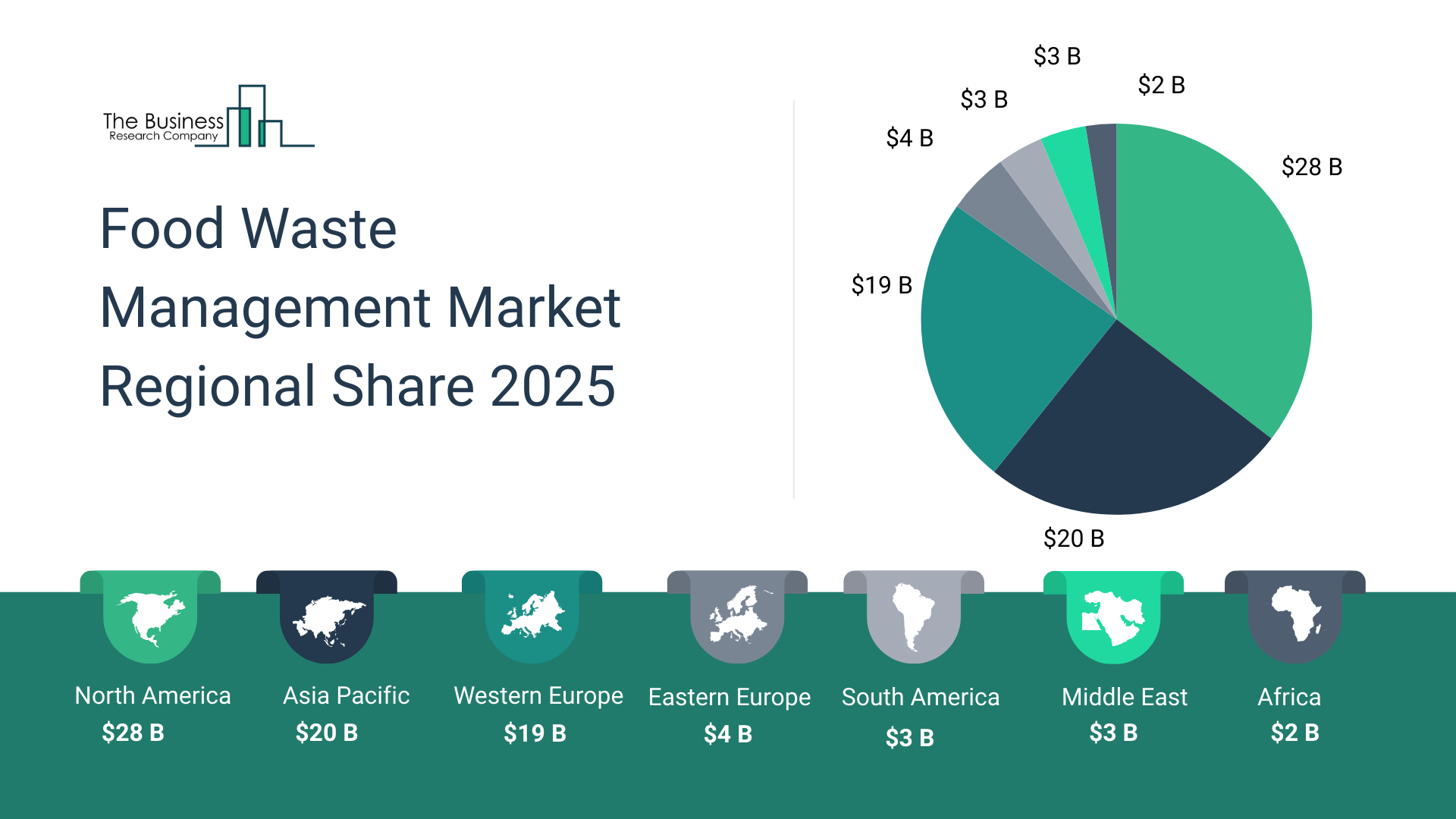
North America will be the largest region in the food waste management market in 2029, valued at $33,885 million. The market is expected to grow from $26,873 million in 2024 at a compound annual growth rate (CAGR) of 5%. The steady growth can be attributed to the rising adoption of smart waste management technologies, rising consumer preference for sustainable packaging and rising government initiatives.
Which Will Be The Largest Country In The Global Food Waste Management Market In 2029?
The USA will be the largest country in the food waste management market in 2029, valued at $30,529 million. The market is expected to grow from $23,356 million in 2024 at a compound annual growth rate (CAGR) of 6%. The strong growth can be attributed to the rising adoption of smart waste management technologies, rising consumer preference for sustainable packaging and rising government initiatives.
Request a free sample of the Food Waste Management Market report:
https://www.thebusinessresearchcompany.com/sample_request?id=13149&type=smp
What will be Largest Segment in the Food Waste Management Market in 2029?
The food waste management market is segmented by waste type into cereals, dairy and dairy products, fruits and vegetables, meat and poultry, fish and seafood, oilseeds and pulses, roots and tubers and other waste types. The fruits and vegetables market will be the largest segment of the food waste management market segmented by waste, accounting for 28% or $26,722 million of the total in 2029. The fruits and vegetables market will be supported factors such as the rapid spoilage rate of fresh produce, high wastage rates due to improper handling and storage, seasonal harvests leading to waste surpluses, increased awareness about reducing food waste in households and food service industries, the rich organic composition of fruit and vegetable waste making it ideal for composting and growing efforts to repurpose waste for biofuel production and other applications.
The food waste management market is segmented by service into collection, transportation and disposal and recycling. The collection market will be the largest segment of the food waste management market segmented by service, accounting for 53% or $50,440 million of the total in 2029. The collection market will be supported by factors such as the growing adoption of waste segregation practices in households and commercial sectors, increasing government and institutional initiatives to improve waste collection systems, advancements in collection technologies like smart bins, the rising volume of food waste generated globally, the push for reducing landfill waste and the increasing demand for efficient, cost-effective collection methods to handle food waste more sustainably.
The food waste management market is segmented by source into residential, commercial and industrial. The residential market will be the largest segment of the food waste management market segmented by source, accounting for 47% or $44,798 million of the total in 2029. The residential market will be supported by factors such as increasing awareness of food waste reduction in households, government incentives for residential waste segregation and recycling, the rise in eco-conscious consumer behavior, the growing use of composting and other waste management technologies in homes, the influence of sustainability programs in reducing food waste and rising concerns about the environmental impact of food waste in urban settings.
The food waste management market is segmented by application into feed, fertilizers, biofuel, power generation and other applications. The feed market will be the largest segment of the food waste management market segmented by application, accounting for 46% or $44,299 million of the total in 2029. The feed market will be supported by factors such as the increasing demand for alternative animal feed sources, rising awareness of the environmental benefits of utilizing food waste in animal feed, the growing use of food waste as a valuable resource in the agriculture sector, the rising popularity of plant-based feed ingredients, the development of advanced processing technologies for converting food waste into feed and growing regulations supporting the use of food waste in animal nutrition.
The food waste management market is segmented by end-user into primary food producers, food manufacturers, food distributors and suppliers, food service providers and municipalities and households. The municipalities and households market will be the largest segment of the food waste management market segmented by end-user, accounting for 39% or $37,702 million of the total in 2029. The municipalities and households market will be supported by factors such as increasing local government initiatives to reduce food waste, the rise in eco-consciousness among consumers, growing interest in composting and home waste recycling systems, governmental policies promoting food waste reduction at the household level and rising awareness of food waste's environmental and social impacts.
What is the expected CAGR for the Food Waste Management Market leading up to 2029?
The expected CAGR for the food waste management market leading up to 2029 is 5%.
What Will Be The Growth Driving Factors In The Global Food Waste Management Market In The Forecast Period?
The rapid growth of the global food waste management market leading up to 2029 will be driven by the following key factors that are expected to industrial quality assurance, manufacturing, supply chain, and sustainability practices worldwide.
Favorable Government Incentives - The favorable government incentives will become a key driver of growth in the food waste management market by 2029. Favorable government incentives refer to financial benefits, tax breaks, grants, or regulatory support provided by the government to encourage specific industries or activities. Favorable government incentives drive food waste management by providing financial support, tax benefits and regulatory frameworks that encourage businesses, farms and organizations to reduce waste and redistribute surplus food. As a result, the favorable government incentives are anticipated to contributing to a 1.5% annual growth in the market.
Adoption Of Circular Economy Practices - The adoption of circular economy practices will emerge as a major factor driving the expansion of the food waste management market by 2029. Circular economy practices focus on sustainability by reducing waste, improving resource efficiency, and extending product lifecycles through methods like recycling, reusing, refurbishing, and remanufacturing. This shift is gaining traction due to stricter regulations, cost advantages, rising consumer and investor interest, and advancements in recycling and resource recovery technologies. These practices contribute to food waste management by reducing waste, redistributing surplus food, and converting byproducts into valuable resources such as animal feed, bioenergy, and compost. Consequently, the adoption of circular economy practices capabilities is projected to contributing to a 1.0% annual growth in the market.
Increasing Demand For Renewable Energy - The increasing demand for renewable energy processes will serve as a key growth catalyst for the food waste management market by 2029. Renewable energy, sourced from naturally replenishing resources like solar, wind, and hydropower, provides sustainable and eco-friendly alternatives to fossil fuels. This surge in demand is fueled by environmental concerns, government policies, technological advancements, energy security, and corporate sustainability initiatives. It also supports food waste management by encouraging the use of organic waste for biogas and biofuel production, reducing landfill waste, lowering greenhouse gas emissions, and advancing a circular economy. Therefore, this increasing demand for renewable energy across digital manufacturing operations is projected to supporting to a 1.0% annual growth in the market.
Consumer Demand For Sustainable Practices- The consumer demand for sustainable practices will become a significant driver contributing to the growth of the food waste management market by 2029. Sustainable practices focus on strategies that reduce environmental impact, enhance resource efficiency, and promote long-term ecological balance. This growing demand is driven by increased consumer awareness, stricter regulations, corporate sustainability initiatives, concerns about climate change, and the economic benefits of resource efficiency. These practices contribute to food waste management by reducing overproduction, encouraging recycling and composting, and supporting circular economy models. Consequently, the consumer demand for sustainable practices is projected to contributing to a 0.5% annual growth in the market.
Access the detailed Food Waste Management report here:
https://www.thebusinessresearchcompany.com/report/food-waste-management-global-market-report
What Are The Key Growth Opportunities In The Food Waste Management Market in 2029?
The most significant growth opportunities are anticipated in food waste-to-feed market, the residential food waste management market, the food waste collection and management market, the food waste management in municipalities and households market and the fruits and vegetables waste management market. Collectively, these segments are projected to contribute over $44 billion in market value by 2029, driven by increasing global focus on food sustainability, government regulations to reduce food waste, growing adoption of circular economy practices, and technological innovations in waste collection, processing, and conversion. This surge reflects the accelerating implementation of smart waste management solutions, supply chain optimization, and value-added utilization of waste for feed and other applications, fueling transformative growth within the broader fruits and vegetables waste management industry.
The food waste-to-feed market is projected to grow by $10,731 million, the residential food waste management market by $9,828 million, the food waste collection and management market by $9,703 million, the food waste management in municipalities and households market by $7,870 million and the fruits and vegetables waste management market by $5,385 million over the next five years from 2024 to 2029.
Learn More About The Business Research Company
The Business Research Company (www.thebusinessresearchcompany.com) is a leading market intelligence firm renowned for its expertise in company, market, and consumer research. We have published over 17,500 reports across 27 industries and 60+ geographies. Our research is powered by 1,500,000 datasets, extensive secondary research, and exclusive insights from interviews with industry leaders.
We provide continuous and custom research services, offering a range of specialized packages tailored to your needs, including Market Entry Research Package, Competitor Tracking Package, Supplier & Distributor Package and much more.
Disclaimer: Please note that the findings, conclusions and recommendations that TBRC Business Research Pvt Ltd delivers are based on information gathered in good faith from both primary and secondary sources, whose accuracy we are not always in a position to guarantee. As such TBRC Business Research Pvt Ltd can accept no liability whatever for actions taken based on any information that may subsequently prove to be incorrect. Analysis and findings included in TBRC reports and presentations are our estimates, opinions and are not intended as statements of fact or investment guidance.
Contact Us:
The Business Research Company
Americas +1 310-496-7795
Europe +44 7882 955267
Asia & Others +44 7882 955267 & +91 8897263534
Email: info@tbrc.info
Follow Us On:
LinkedIn: https://in.linkedin.com/company/the-business-research-company"
Oliver Guirdham
The Business Research Company
+44 7882 955267
info@tbrc.info
Visit us on social media:
LinkedIn
Facebook
X
Legal Disclaimer:
EIN Presswire provides this news content "as is" without warranty of any kind. We do not accept any responsibility or liability for the accuracy, content, images, videos, licenses, completeness, legality, or reliability of the information contained in this article. If you have any complaints or copyright issues related to this article, kindly contact the author above.
