

Bringing you the latest news on consumer products
Provided by AGP
Employers Are Expanding Reproductive Health Benefits, Yet 63% Still Don't Stock Free Period Products, New Report Finds

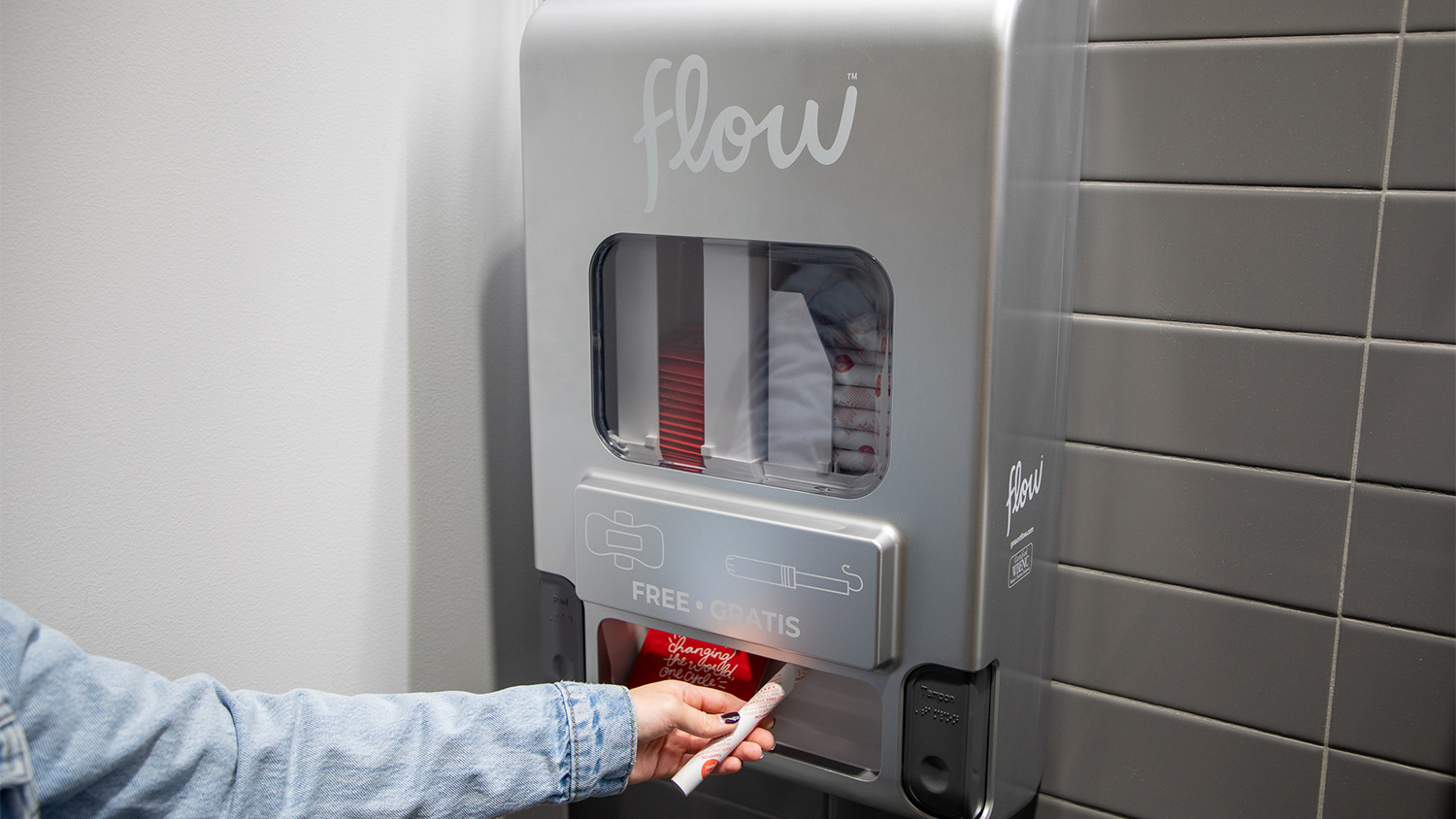
A woman retrieves a tampon from an Aunt Flow dispenser in a workplace restroom.
Not a single company leave policy reviewed over two years references menstrual health, even as one in four now covers fertility and prenatal care.
Over 60% of women have had to leave work to get tampons and pads that are not available in the office. If toilet paper is offered for free, why aren’t tampons and pads?”
— Claire Coder, Founder and CEO of Aunt Flow
NEW YORK, NY, UNITED STATES, May 8, 2026 /EINPresswire.com/ -- U.S. employers have expanded fertility, maternal, and family-formation benefits in recent years. Yet, menstrual health — the most common reproductive health experience — remains largely absent from workplace policy and infrastructure, according to a new trend report released today by Reproductive & Maternal Health Compass (RMH Compass). The findings arrive ahead of Menstrual Hygiene Day on May 28 and Period Poverty Awareness Week, which are increasingly drawing employer attention to the gap.
The Period Pivot: Tapping the ROI of Supporting Menstrual Health in the Workplace draws on more than two years of proprietary employer data collected through the RMH Compass Performance Standard, a framework that evaluates how employers support reproductive and maternal health across health plans, benefits, workplace policies, and work environment.
Key findings:
● 63% of employers evaluated do not provide free period products in workplace bathrooms, leaving employees to manage a routine health need without basic workplace accommodation.
● None of the company leave policies reviewed over the past two years reference menstrual health support, compared with roughly one in four that do reference fertility treatments, prenatal appointments, or other reproductive health needs.
● Only 20% of women feel comfortable discussing menstrual health needs with their manager.
● An estimated 42 million U.S. women experience painful menstrual symptoms, and roughly 3.5 million find it challenging to function for one to two days each month due to the severity of those symptoms.
A low-cost, high-return workforce investment:
The report frames period care as one of the most cost-effective workforce investments available to HR and benefits leaders. With the help of the new RMH Compass ROI Calculator for Workplace Period Support, a company with 50 female employees using a simple basket-style dispensing method can expect an initial investment of approximately $370 and an ROI of up to 250% in the first year alone, with returns compounding in subsequent years as implementation costs level out.
Workforce impact data cited in the report reinforces the case. In an exploratory workplace study, 94.1% of employees reported more positive emotions after free period care was introduced, while 70.6% noted stronger concentration, and 64.7% experienced improved mental well-being.
“Providing free period products is one of the lowest-cost moves HR leaders can make right now,” said Flory Wilson, founder and CEO of RMH Compass. “It’s practical, visible, and can significantly boost productivity and employee retention.”
The report also identifies a parallel policy opportunity that comes at no cost to employers. Instead of creating a new leave category, organizations can strengthen existing PTO and sick leave policies by updating their language to explicitly cover menstrual symptom management, fertility and prenatal appointments, and menopause-related needs. Such measures will enhance employee satisfaction, reduce turnover, and provide managers consistent guidance without adding spend.
Featured solution partner: Aunt Flow:
The report features a spotlight on Aunt Flow, a woman-owned social enterprise that has stocked over 70,000 restrooms across North America and the UK with free-vend period care dispensing and disposal systems. The company partners with organizations to roll out and maintain period care access across offices, campuses, venues, and other multi-site operations — an implementation challenge the report examines in depth.
“There's a need for more prioritization and action when it comes to period-care in workplaces. Low-cost, high-impact implementation solutions significantly improve workplace experience. Over 60% of women have had to leave work to get tampons and pads that are not available in the office,” said Claire Coder, Founder and CEO of Aunt Flow. “If toilet paper is offered for free, why aren’t tampons and pads? Providing menstrual hygiene products in workplaces tells employees that their basic needs matter.”
Aunt Flow’s workplace case studies include a Fortune 500 financial services corporation that rolled out free period products across 1,200 restrooms across the U.S., as well as Google’s New York offices, where Aunt Flow’s period products are available in both gendered and non-gendered bathrooms.
Other organizations Aunt Flow has partnered with include Paramount, Netflix, Wells Fargo, Apple, Nike, TJX, Warby Parker, Urban Outfitters, and Yahoo!
An emerging compliance dimension
The report sheds light on growing legal risks for HR leaders. A nascent body of case law has begun recognizing endometriosis, uterine fibroids, and severe menstrual disorders as serious health conditions that can qualify for workplace accommodations or disability protections. Endometriosis affects roughly 10% of American women ages 25 to 45.
An estimated 26 million Americans live with fibroids, which disproportionately affect Black women.
About the data
These findings, drawn from organizations evaluated through the RMH Compass Performance Standard, reflect patterns across a diverse group of U.S.-based employers of varying sizes across multiple industries and geographic regions.
Access the RMH Compass ROI Calculator for Workplace Period Support.
About RMH Compass:
Reproductive & Maternal Health Compass (RMH Compass) equips employers to offer best-in-class reproductive, maternal, and parental health for their workers. The RMH Compass Performance Standard helps organizations benchmark their benefits against peers, identify high-impact improvements, and strengthen support for employees across life stages. Learn more at www.rmhcompass.org.
About Aunt Flow:
Founded by Claire Coder in 2016, Aunt Flow is on a mission to ensure everyone has access to period products. Through free-vend ADA-compliant dispensers stocked with organic cotton tampons and pads, Aunt Flow has served thousands of brands, making it easy for companies to create a better employee and guest experience as momentum for menstrual equity legislation continues to build across more than 25 U.S. states. Since 2021, the company has donated over 7.6 million period products to menstruators in need through its corporate impact program. Aunt Flow raised more than $17 million in venture capital from a consortium led by JLL’s strategic investment arm, JLL Spark. Other investors include Harlem Capital and Precursor Ventures. Learn more at www.goauntflow.com.
Nish Amarnath
Lanecraft Lab
+1 917-683-1953
nish.amarnath@lanecraftlab.com
Legal Disclaimer:
EIN Presswire provides this news content "as is" without warranty of any kind. We do not accept any responsibility or liability for the accuracy, content, images, videos, licenses, completeness, legality, or reliability of the information contained in this article. If you have any complaints or copyright issues related to this article, kindly contact the author above.
